Category Archives: Uncategorized

Red Fox Sparrow

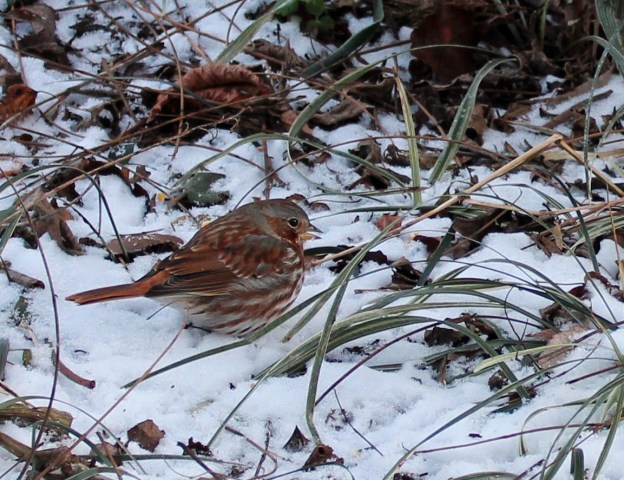
This was no National Geographic photo shoot: there I was, on my belly on the pantry counter, camera lens stuck out the open window into the 11°F early morning air, trying to focus on the RED FOX SPARROW just outside. Two of my cats were trying to squeeze their way out of the slightly open window,  while my husband traipsed back and forth in the nearby driveway, crunching noisily on the ice and snow.  I admit, the photo probably shouldn’t be published, but hey, a Red Fox Sparrow, five feet from my kitchen is newsworthy in my opinion.

What a beautifully colored bird. The Red (or Taiga) Fox Sparrow (Passerella iliaca iliaca) is our eastern subspecies of the Fox Sparrows. “Slate-colored”, “Sooty”, and “Thick-billed”, the other three of the four main subspecies, are all found in specific western areas of the United States. I have seen Fox Sparrows before, but not this closely and I think this one was a perfect specimen. Just look at those lovely cheek patches and thick streaking on breast and flanks! Another interesting thing is the coloring of the beak- all yellow on the bottom, and yellow turning to black on the top of bill. Not a bird commonly seen during breeding season, winter is the time we get to spot them scratching about in the leaves on the ground, searching for food. This little bird was hanging out with several White-throated Sparrows (Zonotrichia albicollis) here in my yard, a fairly northernmost part of it’s winter range. How nicely it blends in with the snowy winter landscape.

~Elizabeth

It snowed today!

I love snow. I had to enjoy viewing it from the windows at work all day, then, just before sunset I was able to get outside for a few photos.

What a beautiful snowfall, outlining all the trees and making it seem possible to see far into the forest and look for bird nests.

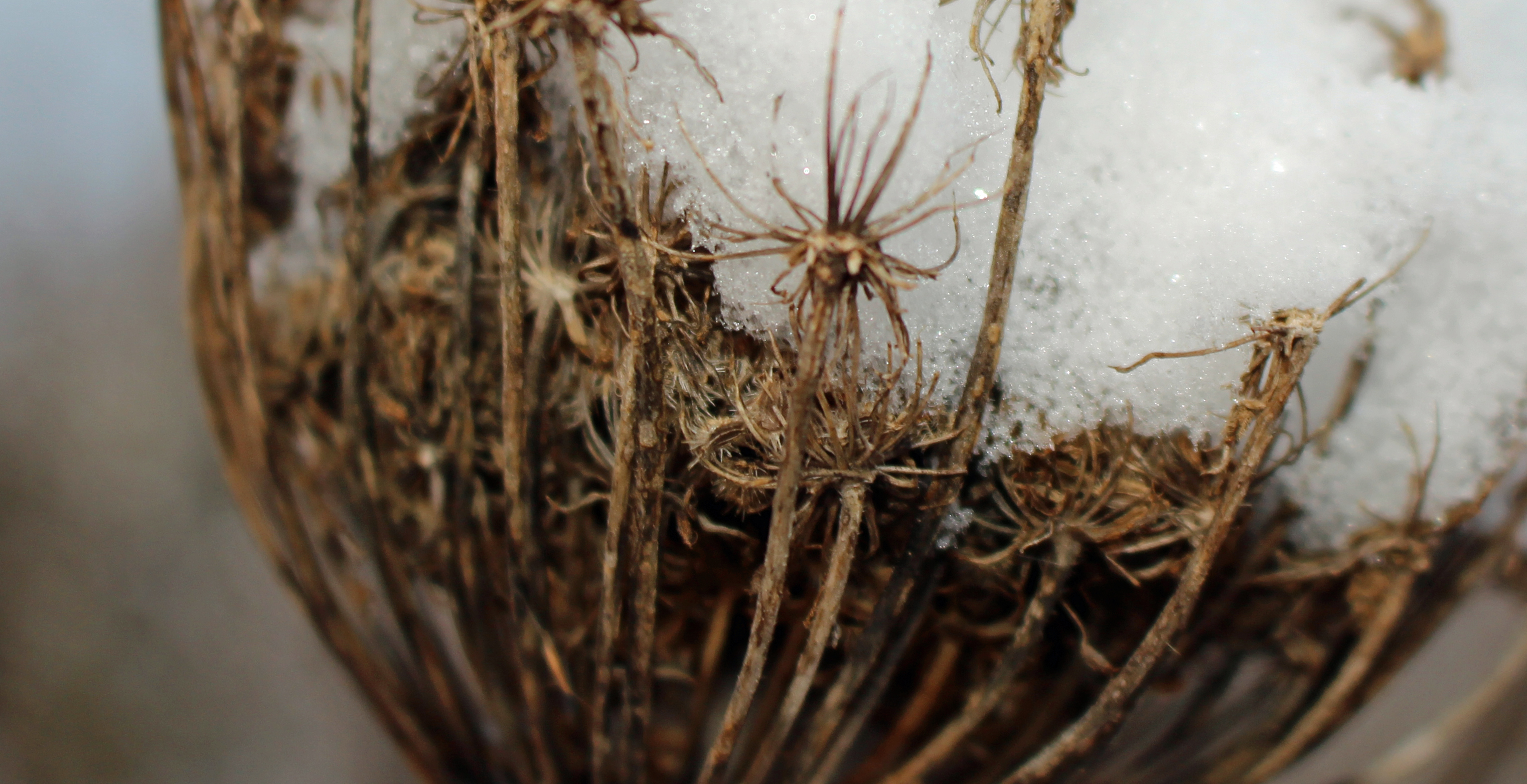
I found plenty of “bird’s nests” of Queen Anne’s Lace (Daucus carota). The nicely snow-capped dried flower heads reminded me of cotton bolls, the fluffy white heads of cotton plants. Neither plant is native to South Jersey, but I do enjoy the pretty white flowers of Queen Anne’s Lace in summer. Also called wild carrot, it is edible, and nutritious. But be careful, it closely resembles Poison Hemlock!

IMG_0194
If you look closer at the of the dried flower, you can see the seeds which are covered in hooked spines. One flower umbel can produce 3,000 seeds.

IMG_0201c

seed

Queen Anne’s Lace seed (David Wagner, Eugene Weekly)

London plane tree; reminds me of a paint-by-number I had as a kid.

IMG_0240

London Plane Tree (Platanus × acerifolia)

~Elizabeth

Clivia has a berry

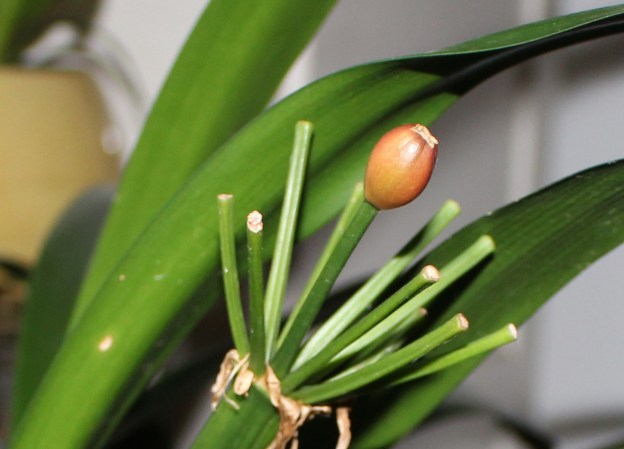
My pride and joy, my kaffir lily, Clivia, has a berry! A potential seed! I have been watching her swollen little ovary since June, when she flowered, to see if a little fruit would develop. It is turning red, and is almost ready to pick.

Clivia has lived with me since 1969, when I purchased her for 10¢ at a church rummage sale in Frankford, Philadelphia. She was just a few strappy little leaves in a tiny pot. Her scientific name is Clivia miniata, from the plant family Amaryllidaceae. Common names include kaffir lily, forest lily, and bush lily. Clivias are native to the moist, shady forest floors of Southern Africa.

She is always producing baby plants, little daughter plants called offsets, which develop from the roots of the mother plant. These are clones of the mother plant. My clivia has had about 20 offsets over the years. Every now and then one of the flowers gets pollinated and a little berry grows, but so far I have not successfully obtained a seed.

Longwood Gardens has an impressive collection of clivias. They started breeding Clivias in 1976 in an attempt to create a spectacular yellow-flowered plant. They successfully accomplished their goal; in 2011 they debuted Clivia miniata ‘Longwood Debutante’ and in 2012 they released their latest yellow flowering plant- Clivia miniata ‘Longwood Fireworks’. You can find them at: http://longwoodgardens.org/gardens/about-our-plants/production/signature-plants/clivia.

Do you have any very special houseplants? Let me know in the comment section.

I will let you know how I make out with Clivia’s berry in the months to come.

~Elizabeth

CliviasIMAG2358_BURST001